What to do when you make a mistake in a newsletter
Anyone who works with newsletters knows the feeling.
You spend time making a good newsletter. You send it to a lot of people. And then you spot a stupid mistake.
Sometimes it is a small thing like a typo, and it hardly matters. Other times it is more serious — an important link missing, or the wrong date. At best your communication falls short of what it could have done; if you sell through your email, it can mean lost revenue.
This is about what you can do when it happens, when a mistake is worth correcting, and a real example from our own sending.
Why handling mistakes well is worth it
We are all human, so mistakes are unavoidable — in email as everywhere else. But owning a mistake gives you the chance to turn an irritating situation into something positive. Admitting one shows self-awareness and a human being at the other end, and that often improves how the recipient sees you.
Beyond that, some mistakes simply have to be corrected, because they change how the recipient understands or acts on your message.
How to handle a mistake in an email already sent
Mistakes in email are frustrating because you cannot fix them after sending. Spot an error in a page on your website and you correct it and publish again. The same goes for an advert. Email gives you no such option, so you need another approach: admit the mistake in a follow-up email.
If you judge the mistake to be significant:
- Write an email admitting it and explaining what happened
- Apologise where an apology is genuinely owed
- Put the mistake right — if an important link was missing, make sure it is in the new email
- Consider offering something by way of apology, such as a discount code
- Decide whether the second email goes to the whole list or only to those who opened the first. Bear in mind that someone can open the first email after you send the second, and so never see the correction
When is a mistake worth correcting?
When you spot one, the first question is whether it is big enough to be worth the time.
As a rule we do not think small spelling or typing errors are. They show there is a real person at the other end, and they are unlikely to make anyone unsubscribe — unless they happen constantly.
For a small mistake in the grey area, you might simply mention it in your next newsletter, to show you noticed.
Mistakes that usually are worth correcting:
- You sent the newsletter too early, or to the wrong recipients
- Content that is factually wrong — dates, prices and the like
- Spelling errors that change the meaning of your message
- Anything that could damage the organisation’s reputation
- Important links missing
If the mistake is in an automated email, you simply fix it and publish the updated flow. Where it is serious enough, you can send to a segment of the recipients who opened that automated email in the last fortnight, explaining and apologising.
Can corrections look insincere?
They can. Correcting mistakes too often starts to look unprofessional.
We have also seen campaigns where mistakes are made deliberately, because they stand out in the inbox — a sales campaign that “accidentally” offers too large a discount, followed by a message saying “well, we made the mistake, so you can have the discount anyway”. It can be an effective sales device. But if the recipient sees through it, it damages your reputation rather than helping it.
How to word the correction
For a large, far-reaching mistake, apologise properly and keep it professional. With newsletters that is rarely the situation. Usually it is a small thing that might mildly irritate someone, and will more often make them smile.
A few things to aim for:
- Admit it and be honest. Sending a follow-up already concedes the point. There is no need for excuses — put your hands up and the recipient will understand.
- Consider humour and a little self-deprecation. It makes the mistake feel smaller, and it makes people smile.
- Include contact details, so anyone with a question can reach you or your support team.
How to make fewer mistakes
It is human to err, but a few habits before sending reduce the odds:
- Set aside time to proofread, and use whatever tools help you catch errors in the text before you build the email
- Send a test to yourself and check every link. While you are there, judge how it looks in the inbox — anything to fix in the design, any paragraphs that run too long?
- Test in mobile view. Most email is opened on a phone, yet most test emails are opened on a computer, simply because that is where you are sitting when you send one to yourself
- Get a colleague to look. Do the sentences work? Are the dates and prices right? A fresh pair of eyes catches what you no longer see, especially after reading the same text many times
A real example
We consider ourselves reasonably expert at email, and we still make mistakes.
One of ours: we used the wrong formatting for a merge field in the very first sentence of a newsletter.
It was supposed to read “Hi” followed by the recipient’s first name. Because of the formatting, the name was never inserted — every recipient got the raw merge tag instead.
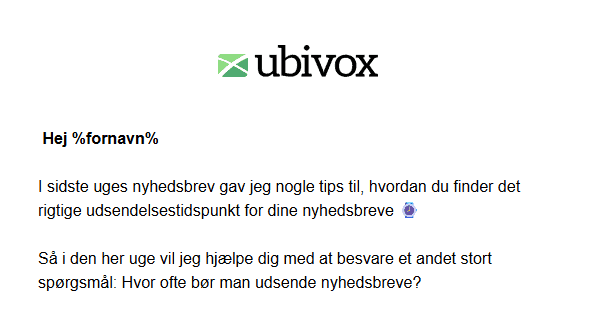
We only noticed once it had gone out. Which left two options:
- Say nothing and hope nobody noticed — which seemed unlikely
- Admit it and put it right
First, though: was the mistake big enough to react to at all?
We decided it was, because it came down to a piece of email technique we of all people should have under control. Had it been a typo or two, we probably would have let it go.
So we sent a follow-up in which we:
- Admitted the mistake
- Added a little humour and self-deprecation
- Turned it into a lesson the recipient could take something from
- Used the occasion to remind people how important it is to send test emails and read them properly
- Linked to our guide on merge fields, so readers could understand what caused it and avoid the same mistake
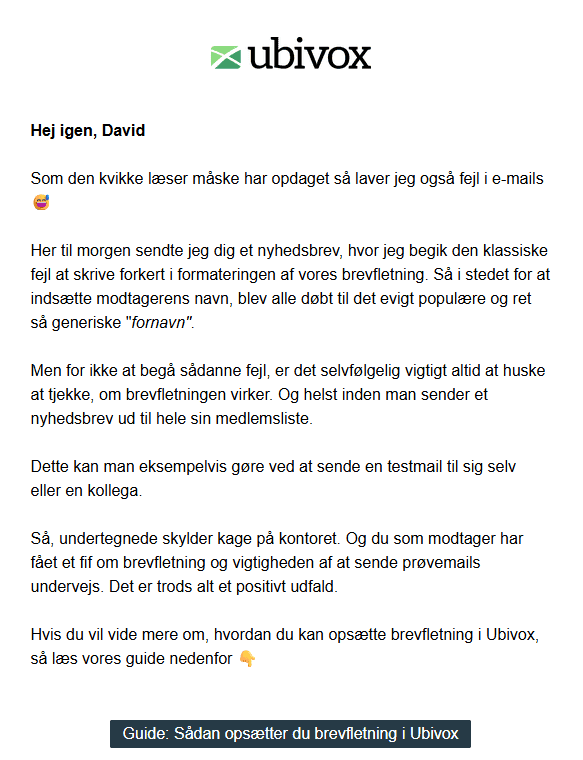
The result: we got a positive response for the self-awareness and the way we handled it — a couple of recipients saw the funny side — and some extra traffic to our guides. All in all, correcting it was worth doing.
If you use the archive
A number of our customers use our archive function, where sent newsletters are kept on a dedicated page on their website. If you do, it is worth removing the newsletter containing the mistake from the archive, along with the correction that followed it.